

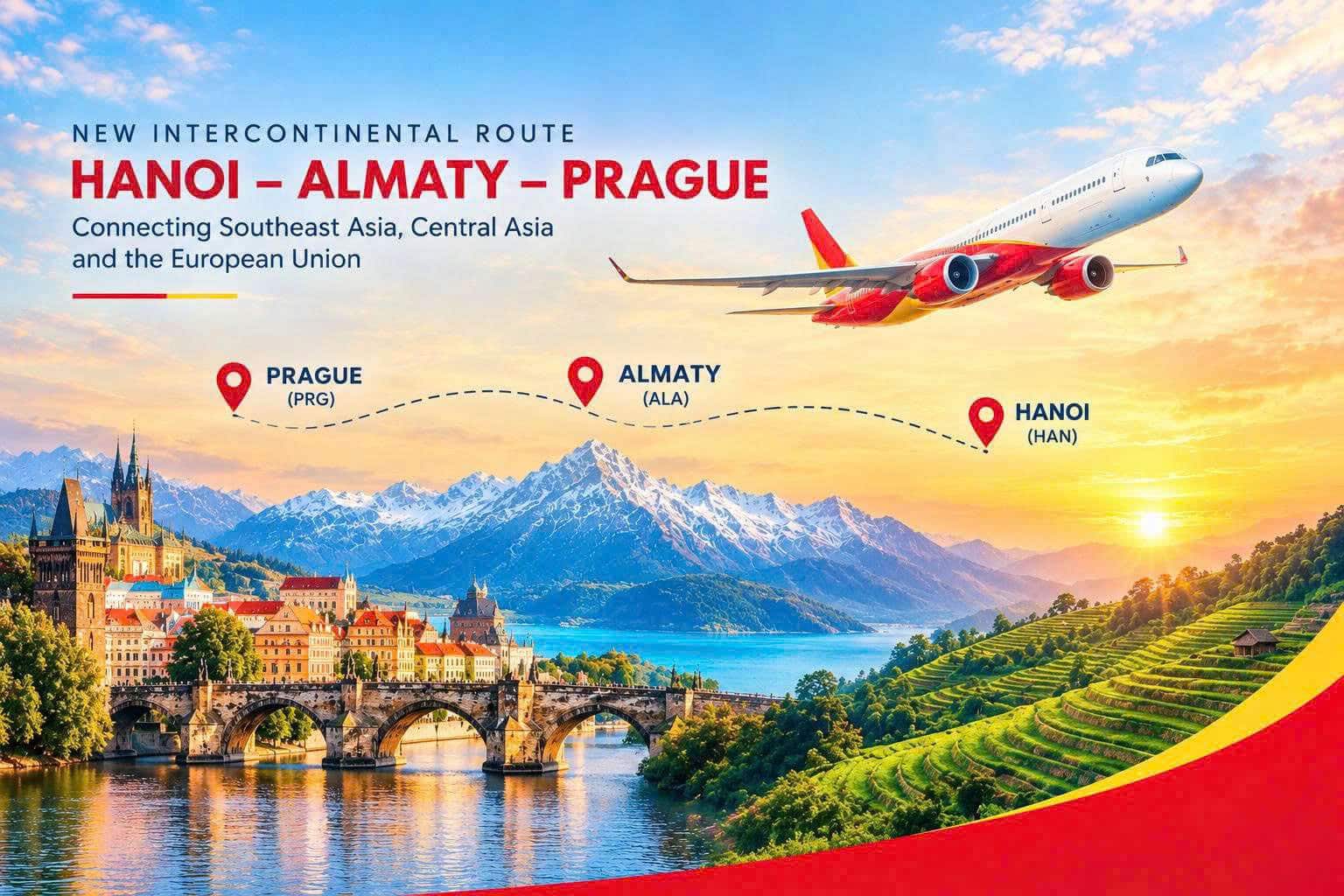
The intercontinental air route connecting Hanoi – Almaty – Prague officially commenced operations on 10 October 2026. This development opens up a strategic aviation corridor linking Southeast Asia, Central Asia, and Central and Eastern Europe. For international tour operators and travel agencies, it presents a valuable opportunity to redesign their travel product portfolios, overcome transit barriers, and tap into high-potential travel markets with the support of a knowledgeable local DMC with in-depth destination expertise.
Strategic Milestone – Connecting Southeast Asia, Central Asia and the European Union
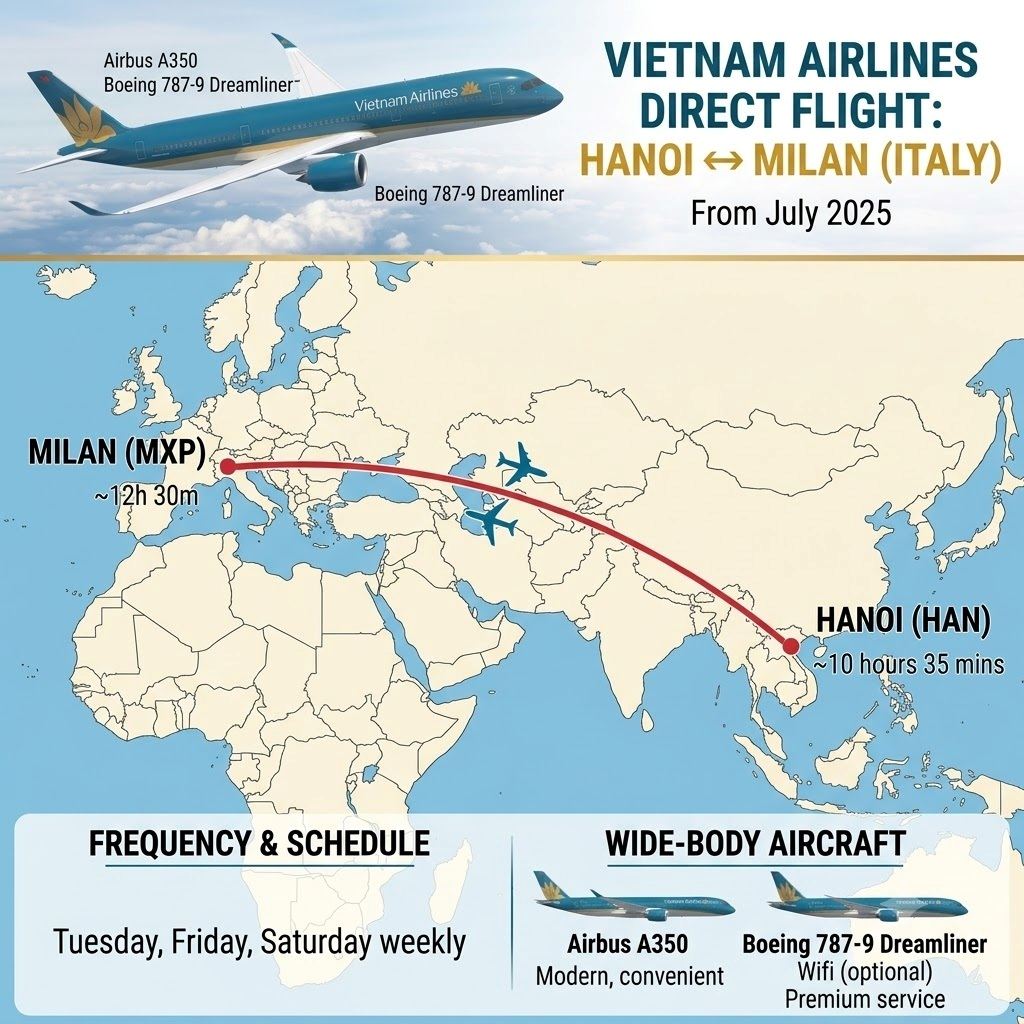
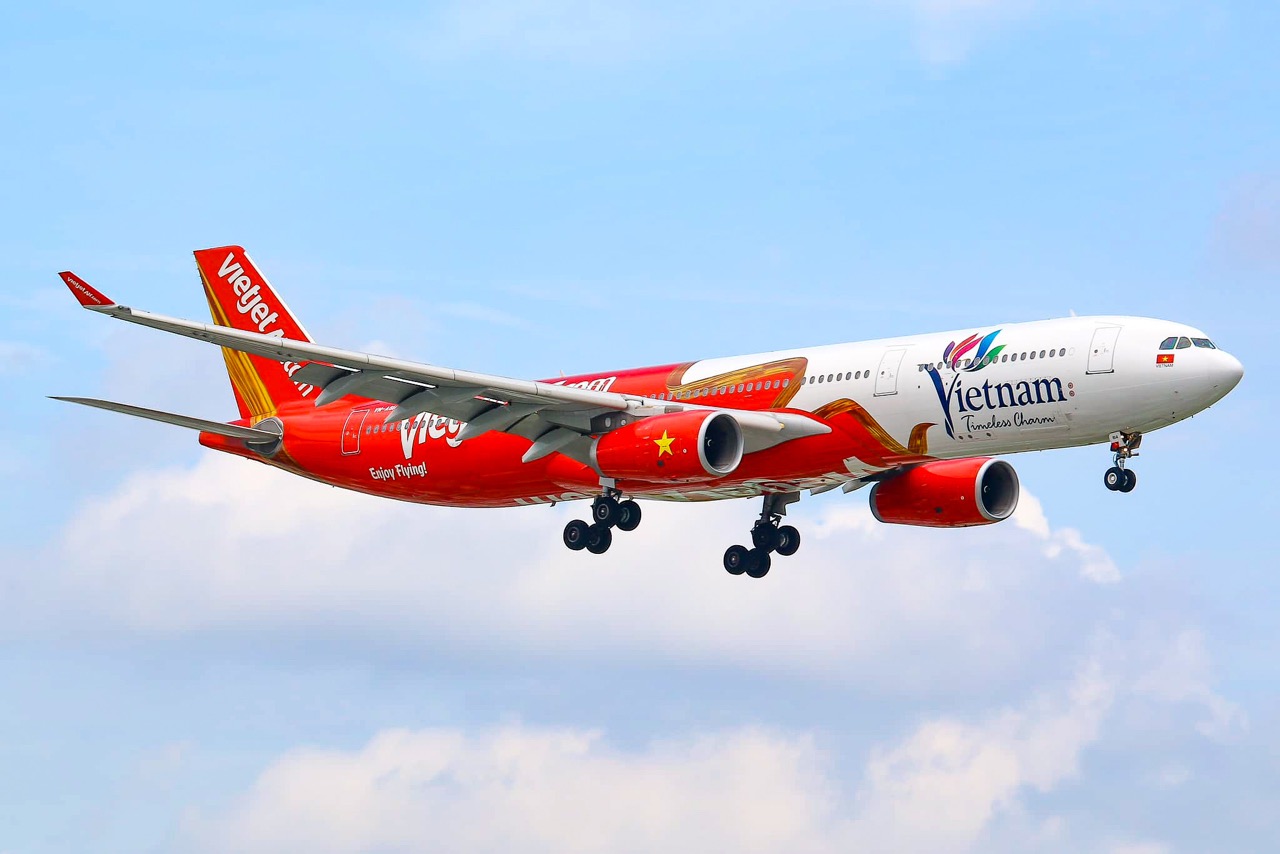
On October 10, 2026, Vietnamese private carrier Vietjet officially launched scheduled transcontinental flight routes connecting Hanoi (HAN) with Almaty (ALA) and Prague (PRG). This milestone marks a significant advancement in intercontinental air connectivity, further strengthening Vietnam’s aviation presence in the European Union.
For international tour operators, wholesalers, and destination management companies across Europe and Central Asia, this new service represents far more than an expansion of the airline’s network. It establishes an efficient, cost-competitive air bridge connecting three distinct regions. In the post-pandemic recovery era, as European long-haul travelers increasingly seek authentic cultural experiences, pristine tropical retreats, and seamless multi-destination itineraries, the new route helps overcome traditional transit barriers, improves price competitiveness, and unlocks a wealth of business opportunities for the global travel trade.
Technical Route Specifications: Essential Operational Data for Product Planners
To effectively engineer group departures (GIT), individual bespoke packages (FIT), and corporate MICE delegations, travel planners require precise operational data. The table below outlines the core technical and commercial parameters of the newly inaugurated service:
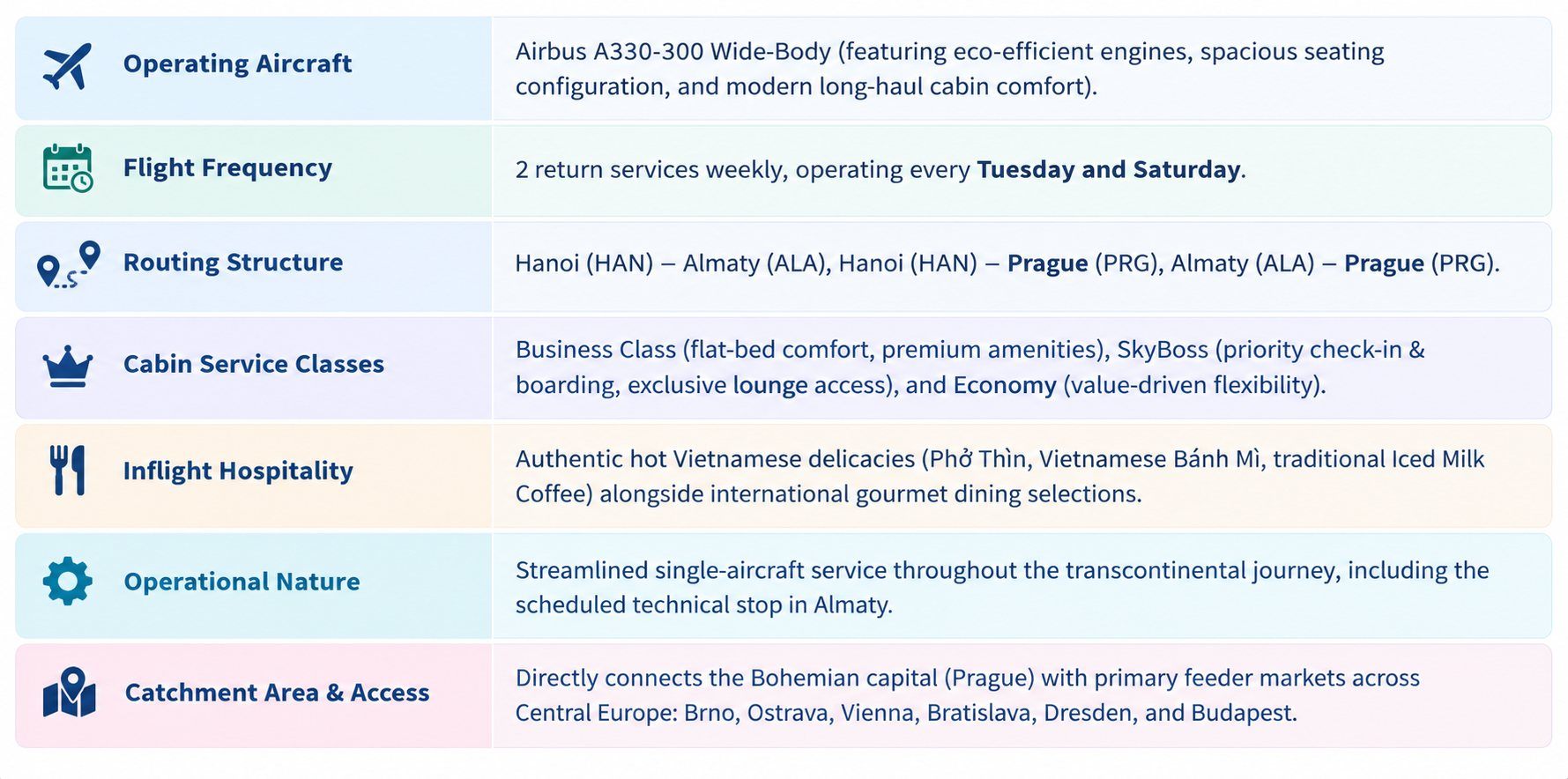
Route Connecting Hanoi – Almaty – Prague: Flight Specifications and Services
Key commercial advantages over legacy aviation hubs
- Overcoming the Hub-and-Spoke Bottleneck: Historically, european tour operators packaging travel from Prague and neighboring Central European capitals had to route travelers through crowded transit megahubs in the Middle East (Doha, Dubai) or Western Europe (Frankfurt, Istanbul, Paris). These itineraries frequently incurred extended 4-to-8-hour layovers, complex baggage transfers, and steep seasonal fare spikes.
- Streamlined journey on a single aircraft: Vietjet’s service allows passengers to remain on board the same wide-body aircraft throughout the technical stop in Almaty. This single-plane continuum substantially diminishes physical travel fatigue and significantly lowers the statistical risk of mishandled connecting luggage.
- Strategic central european gateway: Prague Václav Havel Airport functions as an optimal regional departures hub for travelers residing in Southern and Eastern Germany, Austria, Poland, and Slovakia. With high-speed rail links and short road transfers connecting Brno (2.5 hrs), Dresden (2 hrs), and Vienna (4 hrs) directly to Prague, tour operators can aggregate regional demand under a unified departures program
Market Dynamics: How the New Route Fuels Inbound Growth
Aviation capacity is the fundamental prerequisite of tourism growth; however, understanding the commercial profile of inbound source markets allows product developers to tailor high-converting travel catalogues. The Prague–Almaty–Hanoi axis unlocks two complementary, high-yield traveler segments:
The Czech Republic & Central-Eastern European Travelers
Central European holidaymakers are often drawn to cultural tours, eco-adventures and winter-sun escapes. During the European winter months, particularly from November to April, Vietnam’s tropical beaches, UNESCO-listed heritage sites and wellness retreats can offer attractive options for travellers seeking warmer weather and diverse cultural experiences.
Kazakhstan & the Emerging Central Asian Market
Kazakhstan represents an emerging outbound tourism market, with opportunities to develop travel products tailored to different budgets and preferences. Beach holidays, premium resort stays, golf tourism and wellness experiences can provide potential options for Kazakh travellers considering Vietnam as a long-haul destination. Tour operators can explore these segments by combining suitable accommodation, leisure activities and flexible itineraries based on customer demand.
Seamless Domestic Dispersion from Hanoi Gateway
Landing at Hanoi’s Noi Bai International Airport (HAN), international travelers enter the primary transportation turntable of Northern Vietnam. Leveraging Vietjet’s dense domestic network, tour operators can effortlessly distribute clients onward to Da Nang, Hoi An, Nha Trang, Da Lat, Phu Quoc Island, and Ho Chi Minh City without requiring third-party airline interlining.
Which Vietnam Travel Products Can Tour Operators Develop?
The Hanoi–Almaty–Prague route creates an opportunity for international tour operators to review their Vietnam programmes and explore new product formats. The most suitable approach will depend on the target market, available travel time, flight schedules and customer preferences.
Vietnam offers a broad range of experiences, allowing operators to differentiate their portfolios through itinerary length, travel style and thematic focus.
| Classic Vietnam Circuit: 10–14 Days |
A comprehensive itinerary can begin in Hanoi, continue to Ninh Binh and Ha Long Bay, explore Central Vietnam through Hue and Hoi An, and conclude in Ho Chi Minh City and the Mekong Delta. This format is particularly suitable for first-time visitors seeking a balanced introduction to Vietnam, combining cultural heritage, landscapes, gastronomy and opportunities to discover local life. For tour operators, a classic circuit can serve as the foundation for fixed-departure group tours, seasonal catalogues and customised packages. |
| Northern and Central Vietnam: 7–10 Days |
| For travellers with limited holiday time, a shorter itinerary covering Hanoi, Ninh Binh, Ha Long Bay and Hoi An offers an introduction to some of Vietnam’s most representative destinations. This format may appeal to organised groups and independent travellers who prioritise the quality of their experiences over the number of destinations visited. Its feasibility depends on domestic flight schedules and the time required for transfers. |
| Authentic Vietnam and Experiential Travel |
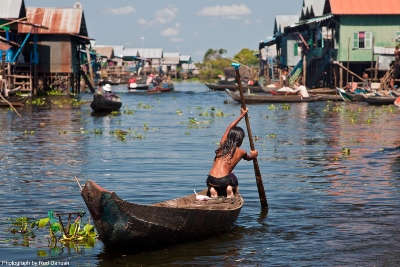
| Beyond traditional sightseeing, Vietnam offers opportunities to develop experience-led programmes built around regional cuisine, local markets, boat trips along the waterways of the Mekong Delta, traditional handicraft workshops and encounters with local communities. For European travellers, combining history, food, traditions and everyday life can provide a distinctive selling point. These experiences can also be incorporated into classic circuits to create more engaging itineraries without significantly extending their duration. |
| Premium and Tailor-Made Vietnam |
| Boutique hotels, characterful accommodation, private guides, personalised transfers, curated culinary experiences and carefully selected activities can form the basis of premium travel products. This segment offers potential for agencies specialising in tailor-made holidays, honeymoons, special occasions and high-end travel. Flexible service levels also allow operators to create packages for different budgets and customer expectations. |
| Multi-Country Journeys: Vietnam, Cambodia and Laos |
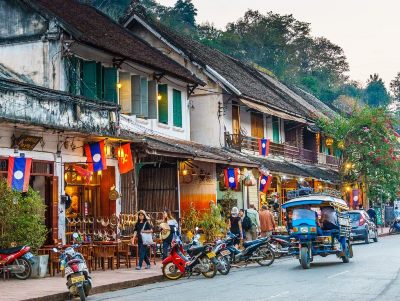
| For customers planning longer holidays, Vietnam can serve as the starting point for multi-country journeys across Indochina. Extensions to Cambodia or Laos allow tour operators to broaden the travel experience through additional cultural, historical and natural attractions. |
How Can Tour Operators Make the Most of the New Route connecting Hanoi-Almaty-Prague?
The commercial value of the Hanoi–Almaty–Prague connection will depend on how effectively operators align their products with flight availability, fares and the needs of their target customers.
Firstly, fixed-Departure Group Tours
The route may provide an additional option for planning group departures to Vietnam, subject to confirmed schedules, seat availability and commercial conditions.
Operators can use these details to assess departure dates, coordinate hotel allocations and arrange ground services in advance. Before publishing a programme or confirming a group, they should verify the applicable fares, ticketing conditions and operational arrangements, including the stop in Almaty.
Secondly, independent Travel and Small Groups
Not every traveller requires a fixed itinerary. Flexible departure dates, private arrangements and modular service combinations allow agencies to serve couples, families, friends travelling together and small private groups.
This approach can also help operators accommodate different lengths of stay and budgets while maintaining a consistent standard of destination services.
Thirdly, seasonal Programming
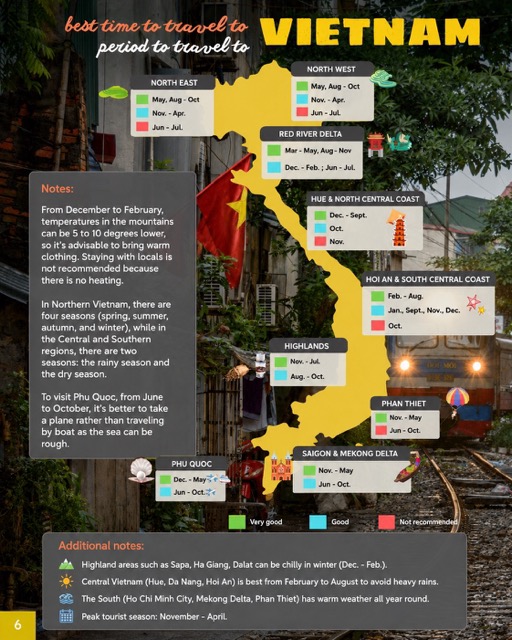
Vietnam’s climate varies considerably between the North, Central Vietnam and the South. Product planning should therefore account for regional weather patterns, seasonal demand and the activities available during each period.
Rather than promoting a single itinerary throughout the year, operators can adapt their departure calendars and recommend the most suitable regions and experiences for each season.
Fourthly, Products and Niche Markets
Gastronomy, photography, architecture, UNESCO-listed heritage sites, nature and responsible tourism offer opportunities to create more specialised programmes.
Themed itineraries can help operators reach clearly defined customer segments, strengthen their catalogue positioning and develop targeted digital marketing campaigns.
Finally, combining Vietnam with Other Asian Destinations
For travellers seeking an extended holiday, Vietnam can be combined with Cambodia, Laos or other destinations in the region.
Such extensions should be designed around confirmed flight schedules, realistic transfer times and sufficient time at each destination. The Hanoi–Almaty–Prague service should be assessed as one possible international routing option rather than assumed to be the most suitable choice for every itinerary or market.
The Role of a DMC: Turning Air Connectivity into a Marketable Product
Improved air connectivity creates opportunities, but a successful travel product also requires well-designed itineraries, reliable suppliers and coordinated operations on the ground.
For international tour operators and travel agencies, working with a Destination Management Company (DMC) in Vietnam provides access to local destination knowledge, established supplier relationships and operational expertise.
A local DMC can support partners with:
- Itinerary development: Designing FIT and GIT programmes, from classic circuits to tailor-made journeys.
- Supplier coordination: Selecting and coordinating hotels, restaurants, transport providers, guides and activity suppliers.
- Product differentiation: Developing itineraries with different service levels, price points and thematic focuses.
- Reservation management: Coordinating bookings and ground services across multiple destinations.
- On-the-ground assistance: Providing operational support and responding to unexpected situations during the trip.
- MICE and incentive travel: Creating programmes for corporate groups, incentive travel and business events.
- Seasonal adaptation: Updating itineraries according to regional conditions, supplier availability and customer requirements.
For overseas partners, this cooperation helps reduce the operational burden of building and maintaining a supplier network in Vietnam. It also allows tour operators to focus on distribution, customer relationships and sales while relying on a specialised local partner for destination arrangements.
A DMC with regional expertise can additionally support multi-country itineraries across Vietnam, Cambodia and Laos, helping partners coordinate services across different destinations.
Turning New Air Connectivity into B2B Opportunities
The Hanoi–Almaty–Prague route offers an additional opportunity for the travel trade to assess new ways of developing Vietnam programmes and reaching potential customers across connected markets.
The commercial opportunity lies not simply in adding Vietnam to a catalogue, but in identifying the right product for each market: classic circuits for first-time visitors, experiential journeys for culturally curious travellers, premium tailor-made holidays and multi-country itineraries for longer stays.
To translate improved connectivity into tangible results, three elements need to work together: reliable flight planning, products aligned with customer demand, and effective destination operations.
DMC Mekong Image Travel & Events works with international tour operators and travel agencies to design and organise travel programmes in Vietnam, Cambodia and Laos. Its services cover group tours, tailor-made individual travel, incentive programmes and MICE.
By combining local destination expertise with close operational coordination, a DMC can help partners transform travel concepts into practical, market-ready itineraries tailored to their customers.
For further information, quotation requests or the development of new programmes, please contact info@imagetraveldmc.com or visit dmcmekongimage.com.
Man Nguyen Minh-Martín