
When Is the Best Time to Visit Vietnam
Travelers planning a trip to Vietnam often ask: “When is the best time to visit Vietnam?” Choosing the right travel period plays a crucial role in ensuring a successful travel experience. Rainfall—including precipitation, fog, and other weather conditions—is the most significant factor, as it may force some tourism businesses to cancel or postpone certain activities. Temperature, on the other hand, generally has less impact, but it helps travelers decide what clothing to pack and whether they should bring rain gear for their journey.
Located in Southeast Asia, Vietnam stretches from the subtropical zone in the north to the tropical zone in the south. It shares borders with Cambodia and Laos to the west, China to the north, and is bordered by the Pacific Ocean along its entire eastern coastline. Like several of its neighboring countries, Vietnam has two main seasons: the dry season and the rainy season. Throughout the year, average temperatures typically range between 25°C and 35°C.
During the dry season, although humidity remains relatively high, many travelers mistakenly assume that it is not the ideal time to visit. In reality, it is quite the opposite, with pleasant temperatures and very little rainfall, making it one of the best periods to explore the country.
As for the rainy season, it is a common misconception that it rains continuously for days or even weeks. While there may be periods of heavy rainfall or occasional typhoon risks, showers most often occur in the late afternoon or evening. This allows travelers to enjoy their daytime excursions comfortably before the rain arrives.
Table of Contents
ToggleWhat Is the Best Time to Visit the Different Regions of Vietnam?
Vietnam is divided into three major regions, each with its own climate and seasonal patterns, as well as distinctive cultural and culinary traditions. This diversity allows visitors to experience a remarkable variety of landscapes, ethnic communities, and local cultures throughout the country.

When Is The Best Time To Visit Vietnam
What Is the Best Time to Visit the Different Regions of Vietnam?
Vietnam is divided into three distinct regions. Each region not only has its own climate and seasonal patterns, but also offers unique cultural and culinary traditions. This diversity gives visitors the opportunity to explore a wide variety of landscapes, ethnic communities, and local experiences throughout the country.
Best Time to Visit Northern Vietnam
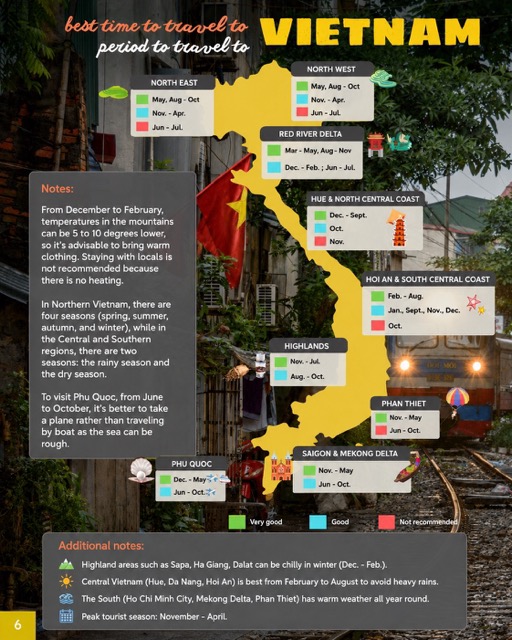
Northern Vietnam is the only region of the country that experiences what can truly be described as a winter season. Winter lasts from December to February, with average temperatures ranging between 10°C and 20°C. As heating is not commonly used in local homes and accommodations, it is important to bring warm clothing to stay comfortable during this period.
In the Northwest, May marks the beginning of the rice planting season. At this time, the rice terraces are covered with water, creating stunning reflections across the mountainsides while local farmers begin cultivating the fields. From July onwards, the terraces turn into endless shades of vibrant green. From October to early November, the rice harvest season transforms the landscape into a spectacular sea of golden terraces.
From June to the end of July, the region enters summer, also known as the monsoon season. During this period, the weather becomes warmer and more humid, with temperatures often exceeding 30°C and frequent rainfall. It is generally considered the least favorable time to visit Northern Vietnam, as heavy rains may also increase the risk of landslides in the mountainous areas.
In the northern valleys and plateaus, particularly around Mai Chau, Hoa Binh, and Pu Luong, there is an additional rice-growing season that runs from February to May. Unlike the Northwest, this area is characterized by broad, flat rice fields rather than terraced landscapes.
Best Time to Visit Central Vietnam
Central Vietnam is slightly wetter than the rest of the country. The region experiences significant rainfall between September and January, with a higher risk of flooding from October in Hoi An to November in Hue. Despite the wet weather, temperatures can still exceed 30°C.
The sunniest period, offering the most pleasant travel conditions along the Pacific coastline—including Hoi An, Da Nang, and Hue—is during the latter part of the dry season, from February to August. Temperatures generally hover around 30°C, providing warm sunshine and ideal conditions for sightseeing and beach activities.
Best Time to Visit Vietnam’s Central Highlands
Due to the influence of tropical weather systems from the East Sea, the Central Highlands, including Kon Tum and Buon Ma Thuot, may experience scattered showers during August, September, and October. These rains can make roads slippery, so long-distance trekking is generally not recommended during this period.
November, December, and January are considered the best months to visit the Central Highlands. After the rainy season, waterfalls are at their fullest, creating spectacular natural scenery.
May, June, and July are also excellent months for exploring the Central Highlands through hikes across traditional villages and national parks. However, don’t forget to bring a hat and sunscreen, as temperatures can be quite high.
Best Time to Visit Southern Vietnam
The best time to visit Southern Vietnam is during the dry season, from November to May, when visitors can enjoy plenty of sunshine. Daytime temperatures generally range from 30°C to 35°C, cooling slightly in the evening.
The rainy season lasts from late May to November, with rainfall occurring on more than 20 days per month, usually in the late afternoon. Temperatures remain relatively stable, averaging between 25°C and 30°C.
Although short afternoon showers are common, this season also brings higher water levels to the Mekong River, creating ideal conditions to admire lush landscapes dotted with blooming lotus flowers.
If you plan to visit the islands of Phu Quoc or Con Dao between June and October, flying is recommended rather than traveling by boat, as ferry services are frequently cancelled due to rough sea conditions.