


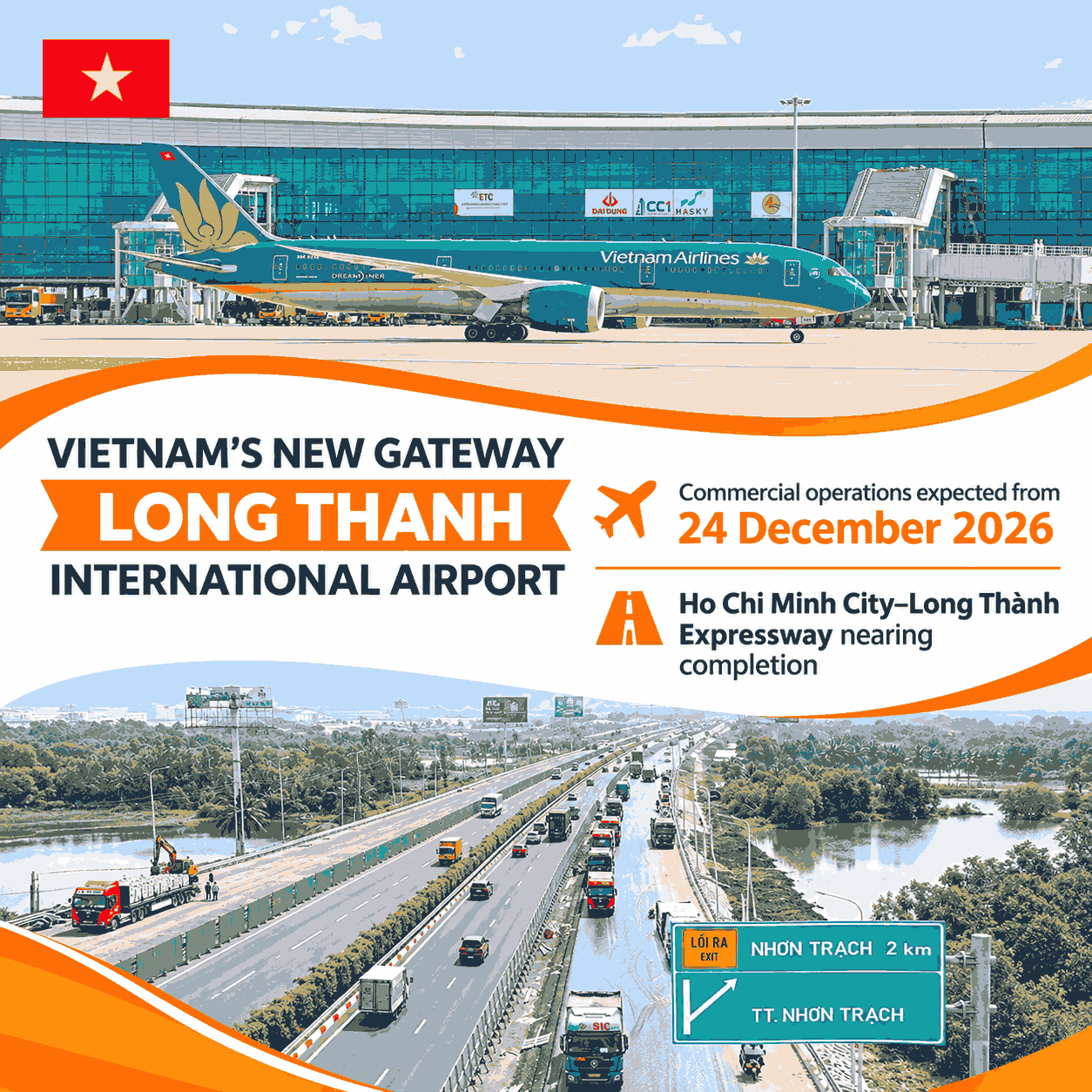
In the coming weeks, southern Vietnam’s aviation and inbound tourism landscape is set to undergo its most significant logistical transformation in decades. According to an official notification sent by Airports Corporation of Vietnam (ACV) to the People’s Committee of Dong Nai Province, the new Ho Chi Minh International Airport, designed to permanently relieve congestion at Tan Son Nhat, will commence commercial operations at midnight on 24 December 2026.
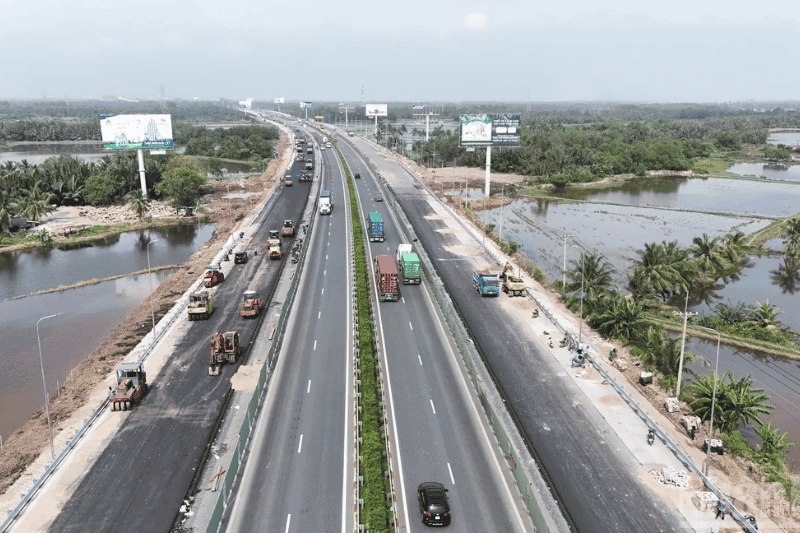
On the ground, construction of the expressway directly connecting the southern metropolis to Long Thanh Airport has entered its final acceleration phase, with the aim of ensuring smooth access from its opening at the end of the year.
For production directors, product managers and operations managers at European tour operators, this launch represents far more than a simple geographical relocation. It marks the beginning of a new dual-airport ecosystem whose operational implications must be anticipated now, particularly when preparing travel catalogues for 2027.
Two airports, Two functions: The new aviation landscape
Contrary to initial concerns about an abrupt and exclusive transfer of operations, civil aviation authorities and Airports Corporation of Vietnam (ACV) have approved a complementary operating model governed by market demand rather than rigid administrative allocation. The historic Tan Son Nhat Airport (SGN) will not cease operating international flights. Its capacity – enhanced by the reconfiguration of Terminal T1 and the opening of Terminal T3 – will focus on domestic flights, regional connections of less than 1,000 kilometres to Cambodia, Laos and Thailand, as well as business travellers arriving directly in the heart of the metropolis.
By contrast, the new Ho Chi Minh International Airport will handle large intercontinental aircraft, long-haul operations, charter flights and heavy cargo. From its first phase, Long Thanh Airport will offer an annual capacity of 25 million passengers and 1.2 million tonnes of cargo, supported by a 4,000-metre Category 4F runway capable of accommodating aircraft such as the A380, B777 and A350 without restrictions.
Transition Timeline: A gradual rollout in three phases
For tour operators scheduling departures from Europe, the transition will follow a progressive three-phase timeline.
- Phase 1 (December 2026 – March 2027): The operational testing period will begin on the night of 24 December 2026. During these first months, Vietnam Airlines and Vietjet will operate a limited number of domestic routes from Long Thanh Airport (including flights to Hanoi, Hai Phong and Vinh), alongside a restricted selection of regional connections with lower connecting-passenger volumes, such as Beijing-Daxing, Hong Kong, Guangzhou and Manila. To protect existing individual and group bookings for the 2026–2027 winter season, direct flights from Paris, Frankfurt and London will continue landing at Tan Son Nhat.
- Phase 2 (March 2027 – October 2027): The real turning point for tour operators will come with the launch of Summer 2027 programmes in late March. At this stage, Vietnam Airlines and its partner carriers will transfer most of their flights from Europe, Australia and the Americas to the new Ho Chi Minh International Airport, bringing operations to approximately 50% of its nominal capacity.
- Phase 3 (from autumn 2027): Long Thanh Airport will reach its planned full operational capacity, stabilising all operations associated with its first development phase.
Connections and domestic flights: Eliminating the risk of Inter-Airport transfers

From a purely operational perspective, this new arrangement removes the concern of complex ground transfers for passengers continuing their journeys to Central Vietnam or the islands. Domestic airlines will establish fleets of Airbus A320 and A321 aircraft directly at Long Thanh Airport from the first quarter of 2027. Vietjet will operate between 26 and 42 daily flights to Da Nang, Hue and Phu Quoc, while Vietnam Airlines will adjust its domestic frequencies to match the schedules of intercontinental flights.
For classic North–South combined tours connecting through the new Ho Chi Minh International Airport, flight changes will take place within a single terminal, with a standard minimum connection time (MCT) of 90 to 120 minutes. However, if separate tickets combine an international arrival at Long Thanh with a domestic departure from Tan Son Nhat, a minimum four-hour buffer must be allowed to accommodate baggage collection, the road transfer and check-in for the onward flight.
Transfer times and budget adjustments to Saigon
The impact on transfers to accommodation in central Saigon also requires a realistic assessment of costs and travel times. Located approximately 40 kilometres east of the city, in Dong Nai Province, Long Thanh Airport is four times farther from District 1 than Tan Son Nhat. However, thanks to the expansion of the expressway connecting the metropolis to the airport, with sections featuring 8 and 10 lanes, as well as improvements to provincial access roads, the journey by inbound tour operator coach is expected to take between 45 and 60 minutes, barring major disruptions. This is comparable to the 35–50 minutes frequently required to navigate urban congestion around the former airport during peak hours.
Tour operators will nevertheless need to incorporate an estimated 20% to 30% increase in arrival transfer costs into their 2027 land packages, driven by additional mileage and expressway tolls.
A qualitative leap in the Traveller Experience and Inbound Services
Beyond budget adjustments, the arrival of the new Ho Chi Minh International Airport brings significant qualitative improvements to traveller comfort. This modern infrastructure will eliminate prolonged aircraft holding delays that frequently disrupted the first days of tours at Tan Son Nhat. On the ground, terminals equipped with biometric gates will streamline immigration procedures and baggage collection.
For local Destination Management Companies (DMCs), the provision of ground-level parking facilities specifically dedicated to tourist coaches will eliminate the cumbersome logistics of passenger pick-ups and drop-offs in the multi-storey car parks currently in use.
New itinerary opportunities: Rethinking Southern Vietnam without crossing the metropolis
This new geographical location finally opens up unprecedented opportunities for itinerary redesign. Positioned at the crossroads of major expressways, Long Thanh Airport provides access to the coastal resorts of Ho Tram in 1 hour 15 minutes and Phan Thiet / Mui Ne in less than two hours, without having to cross densely populated urban areas.
From 2027 onwards, travel designers will be able to offer clients arriving on overnight flights the option of beginning their journey with a few days of coastal relaxation or heading directly towards the Mekong Delta via the Ben Luc–Long Thanh expressway connection, leaving the discovery of historic Saigon until the end of their stay.
By incorporating the specific characteristics of the new Ho Chi Minh International Airport into their programmes today, tour operators can ensure smoother operations while enhancing the competitiveness and originality of their Vietnam travel offerings.
Laetitia Phuong Ha TRAN – IMAGE Travel & Events
Translated by Minh Man